
ℹ️ ADS
ℹ️ ADS
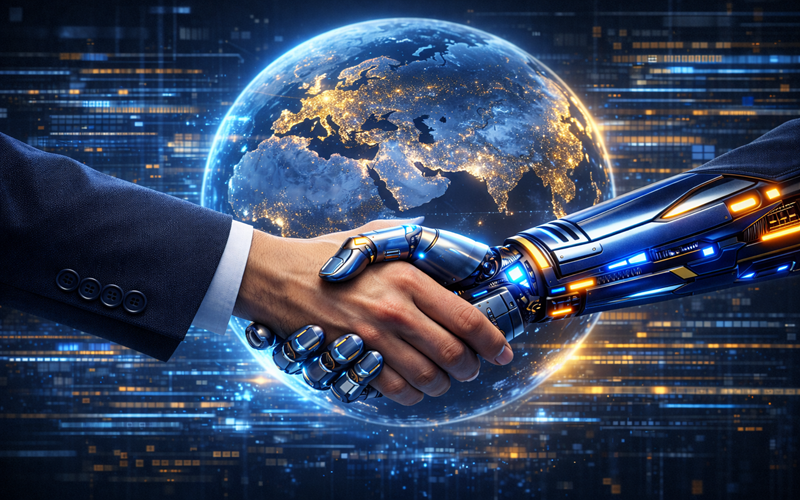
The business landscape in 2026 isn't just fast; it's fragmented. We're moving past the simple adoption of AI and into a phase where the quality of your data, the authenticity of your voice, and your ability to show up in AI-generated answers will decide who leads and who lags. Forget everything you knew about SEO last year. Here are the three non-negotiable trends shaping business success right now.
For the last two years, businesses have been frantically trying to figure out how to use Generative AI. In 2026, the question has evolved. It's no longer "How do we use AI?" but "How does AI understand us?"
Standard AI models like ChatGPT are brilliant generalists—they've "read the internet." But they lack the specific knowledge of your company: your internal rules, your proprietary data, your unique processes. This gap has given birth to a new discipline: Context Engineering .
Think of it this way: In the early 2000s, businesses outsourced their processes. In 2026, they will outsource (and engineer) their "context." The companies that win this year will be those meticulously building a "knowledge map" for their AI. This means:
Curating Internal Data: Feeding AI not just public info, but your sales decks, customer service logs, and product specs in a structured way.
Defining Governance: Teaching the AI what it must not know (to protect trade secrets) and how it should learn from human feedback.
The Rise of "Context-as-a-Service": A whole new industry is emerging to help businesses build these defensible knowledge environments .
The battle on Wall Street and in Silicon Valley is no longer about who has the smartest model; it's about who has the richest, most defensible context .
Consumers are exhausted. They are tired of the polished, algorithm-optimized, AI-generated content that all sounds the same . In 2026, we are seeing a massive shift back to the real, the messy, and the human. Industry commentators are calling this the great "unshittification" of marketing .
For your business, this means:
Show the People Behind the Brand: Go live, show the office, introduce your team. Perfection is now a liability.
Strategic Imperfection: Research shows that while 40% of consumers find brands engaging with trends "cool," 33% find it "embarrassing" . You can't just react; you must be intentional. Your values and voice matter more than jumping on every viral bandwagon.
The Human Touch: As AI floods the zone with generic content, the only thing that stands out is genuine human connection. This doesn't mean abandoning tech; it means using tech to facilitate, not replace, human interaction.
If you're still only optimizing for Google's 10 blue links, you're already late. In 2026, consumers are getting their answers directly from AI chatbots like ChatGPT, Google Gemini, and Perplexity . This has created a new battlefield: Generative Engine Optimization (GEO) .
When a user asks an AI a question, it doesn't show a list of links. It synthesizes a single answer and cites a handful of sources. Research from Princeton University shows that by tweaking your content strategy, you can increase your chances of being cited by up to 40% .
How to win at GEO in 2026:
Add Hard Data: Including statistics in your content can boost visibility as a source by 33.9% .
Cite Experts: Including quotes from recognized authorities increases your citation rate by 32% .
Identify "Opportunity Voids": Look for trending topics where the AI's current answer is generic or lacking specific data . Publish content that fills that specific void with hard facts, and the AI will find you.
The bottom line for 2026: Stop trying to be everything to everyone. Engineer your specific context for AI, be radically authentic to your audience, and optimize to be the answer, not just one of the options.


ℹ️ ADS

ℹ️ ADS



Comments
Leave a Reply