
ℹ️ ADS
ℹ️ ADS
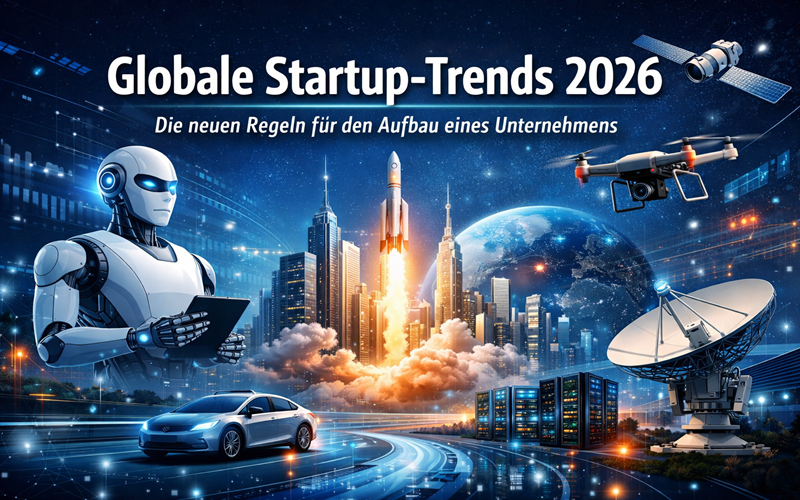
The global startup ecosystem entered 2026 not with a cautious whisper, but with a seismic boom. After a period of recalibration, venture capital is flowing again, but it’s flowing differently. It’s more concentrated, more strategic, and obsessively focused on one thing: real-world application. Forget the hype cycles of the past; 2026 is about tangible value, deep tech, and the infrastructure that will power the next decade. Here are the definitive trends shaping the startup landscape right now.
If February 2026 is any indicator, this will be the year of the mega-round. According to Crunchbase data, global venture investment hit a record-shattering $189 billion in February alone . However, this isn't a broad-based boom. A staggering 83% of that capital—$156 billion—went to just three companies: OpenAI ($110 billion), Anthropic ($30 billion), and Waymo ($16 billion) .
This tells us something crucial: investors are placing massive, concentrated bets on the platforms they believe will underpin the entire AI economy. It’s a “winner-take-most” scenario at the infrastructure layer. For the average startup, the message is clear: don't try to build the next foundation model. Instead, focus on what you can build on top of these platforms.
However, it’s not just about the giants. Four other companies each raised over $1 billion, including Tokyo-based semiconductor manufacturer Rapidus and London-based self-driving platform Wayve . The hardware and semiconductor sectors are seeing a resurgence, driven by the insatiable demand for AI compute power. If you have a solution that optimizes AI chips, cools data centers more efficiently, or solves a specific hardware bottleneck, you are in a prime position to attract attention.
AI is leaping off the screen and into the physical world. Morgan Stanley Research has identified several key areas where private innovators are creating entirely new markets, coining the term “Physical AI” to describe this trend .
Autonomous vehicles are finally hitting an inflection point. After decades of development, AV services are now available in eight major U.S. cities, with 33 consumer launches planned for 2026 . Waymo’s $16 billion raise is a direct bet on this acceleration. It’s not just about robotaxis; it’s about the entire ecosystem of sensors, cameras, and software that powers them.
Defense tech is another explosive sector, particularly in Europe. The war in Ukraine has fundamentally changed the calculus. ZDFheute reports a staggering increase in investments in German defense-tech startups, from just €1.3 million in 2020 to over €890 million in the first nine months of 2025 . Drones, low-altitude robots, and autonomous systems are no longer futuristic concepts; they are urgent necessities. Private drone companies raised over $10 billion from global venture capital in 2025, and with China controlling about 70% of the global drone market, there is a massive strategic gap for Western startups to fill .
Perhaps the most futuristic trend is the race to build data centers in space. Private firms are developing GPU-equipped satellites to create an orbital compute cloud. The advantages are immense: near-perfect cooling efficiency in the -270°C vacuum of space, unlimited solar power, and reduced latency for global edge connectivity . Three private companies in this sector have already raised more than $700 million . It sounds like science fiction, but in 2026, it’s a very real startup opportunity.
The mood in Europe has shifted. While bureaucratic hurdles remain, the continent is rediscovering its appetite for deep tech and industrial innovation. The ZDF report highlights that many new German startups are emerging in KI (AI) and Deep Tech—companies that launch with patents in fields like satellite and drone technology . The optimism is palpable, with the German Startup Association reporting over 1,500 new startups in the first half of 2025 alone, a 9% increase .
However, access to capital remains the biggest bottleneck. Verena Pausder, head of the German Startup Association, points to France as a model, where large institutional investors like pension funds pour money into venture capital, creating globally competitive champions like Mistral . For European startups, the message is to look beyond traditional VC and advocate for policy changes that unlock domestic institutional capital. The technology is world-class; the challenge now is funding its scale-up.
Artificial intelligence isn’t just changing what we build; it’s changing who builds it. At the World Economic Forum in Davos 2026, LinkedIn’s Editor-in-Chief, Daniel Roth, revealed a stunning statistic: there has been a 60% year-on-year rise in users adding “founder” to their profiles . This growth rate is three times higher than it’s been since 2021.
Why? AI tools are dramatically lowering the barriers to entry. Founders can prototype faster, reach customers directly, and compete in capital-intensive sectors with a fraction of the resources previously required . AI is also changing how startups hire. Instead of relying on résumés and job titles, founders are asking candidates to “show what they’ve built.”
At the same time, as Minister Dorothee Bär from Germany noted, societal attitudes toward failure need to evolve. “If someone fails, society still kills them,” she said, arguing that for innovation to thrive, risk-taking must be made more survivable . Whether you are bootstrapping a new SaaS tool or building a deep-tech hardware company, the ability to build, test, and iterate has never been more accessible.
Building a successful startup in 2026 isn’t just about having a great AI model; it’s about giving that model the right context. Most large language models (LLMs) are brilliant generalists, but they lack the specific knowledge of your company or your customer’s industry. This gap has given rise to a new discipline: Context Engineering .
Whether you are developing a legal AI to draft contracts, a medical AI to analyze patient records, or a financial AI to assess risk, the quality of your output depends on the quality of the context you provide. Startups that can master the art of feeding AI agents the right data—at the right time—will have an unassailable advantage over those simply wrapping a generic API. This is the new competitive moat.
For founders looking to monetize their audience or build a sustainable business, understanding these trends is half the battle. The other half is execution. And sometimes, execution means having the right tools and partners. If you're building a community or a content-driven business around these trends, finding the right hosting and infrastructure deals can significantly extend your runway. Whether you are looking for powerful hosting solutions, essential developer tools, or even just the best productivity software to keep your team lean and effective, finding a great deal on essential digital products can make all the difference.
And for your early-stage marketing, every euro counts. Instead of paying full price for software, project management tools, or even design assets, savvy founders are always on the lookout for exclusive coupons and discounts that let them reinvest their savings back into product development. From cloud credits to CRM subscriptions, the ability to save on operational costs is a superpower in itself.
Finally, for a comprehensive overview of the best tools, platforms, and services tailored for modern founders and digital nomads, exploring a trusted deal aggregator can be a game-changer. It’s about working smarter, not harder, and making every dollar work for your startup’s growth.
Despite the AI frenzy, business leaders at Davos warned against “AI-washing.” Laura Alber, CEO of Williams-Sonoma, put it bluntly: “Don’t fake it.” . Expertise and execution still matter. In an AI-driven economy, customers and investors can quickly see through startups that brand themselves around the technology without solving a real problem.
The startup trends of 2026 are defined by a return to fundamentals. It’s about deep tech, physical infrastructure, strategic capital, and the human drive to build. The barriers are lower, but the expectations are higher. The winners will be those who combine the power of AI with genuine expertise, authentic execution, and a relentless focus on solving real-world problems.


ℹ️ ADS

ℹ️ ADS




Comments
Leave a Reply